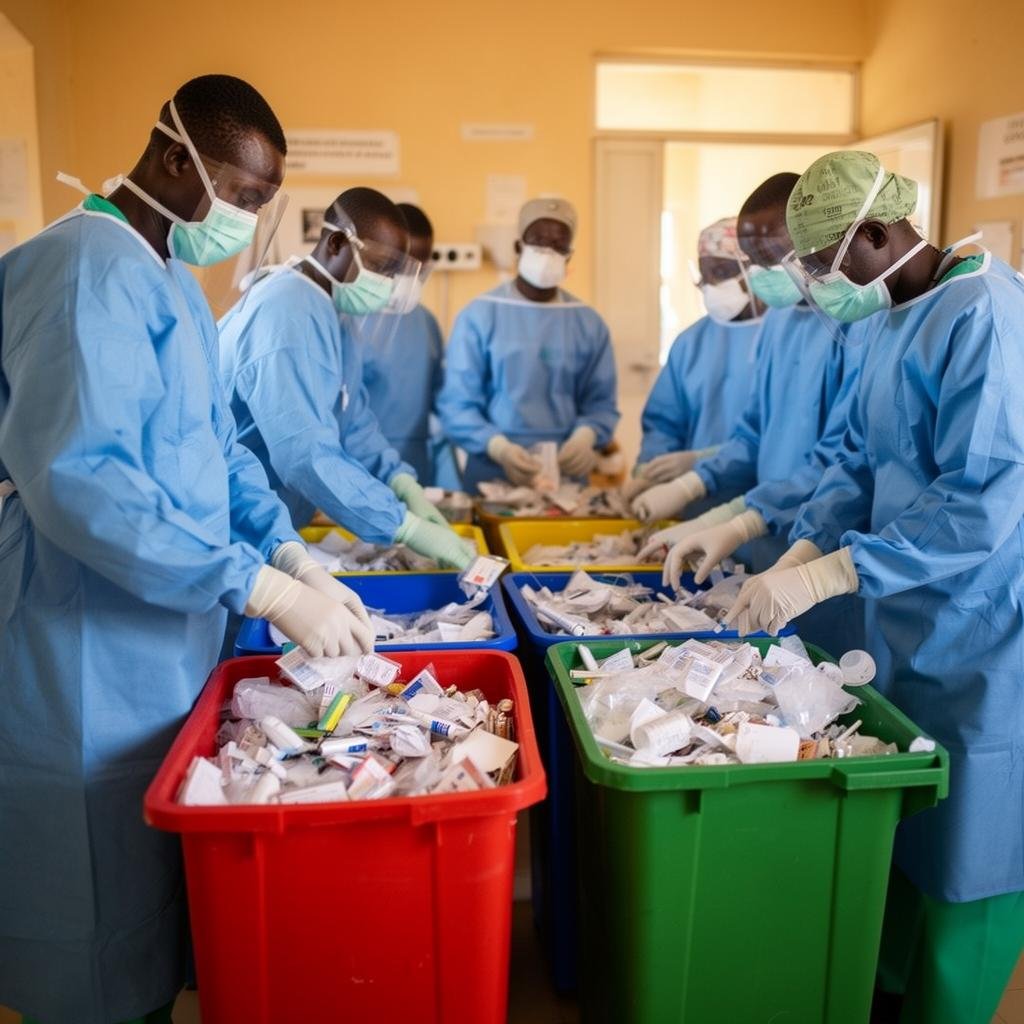
To eliminate the public health and environmental risks of unsafe medical waste disposal in Africa by deploying mobile, solar-powered autoclave sterilization systems that treat infectious waste directly at healthcare facilities
At MedWaste Africa, our work is guided by a deep commitment to health, sustainability, and community impact. We believe that safe medical waste management is not just a technical solution — it’s a human responsibility.
Every decision we make prioritizes the safety of healthcare workers, communities, and patients exposed to infectious waste.
Our solar-powered systems eliminate open burning and reduce toxic emissions — waste management and environmental protection together.
We train local medical staff and build institutional capability so communities can sustain safe waste practices beyond our intervention.
The model is designed for replication — any country, any region, wherever the infrastructure gap exists.
Our approach is structured to ensure measurable impact, scalability, and long-term sustainability across Africa.
Research & Field Assessment Completed
Ground survey conducted in Bamako, Kati, and Koulikoro, Mali to assess medical waste volumes, handling practices, and infrastructure gaps across healthcare facilities.
Key Outputs
Deploy the first mobile autoclave vehicle in Mali, demonstrating safe on-site treatment at healthcare facilities and training a minimum of 50 medical staff per year.
Key Outputs
Expand operations within the pilot country and develop deployment frameworks for additional African countries based on partnership agreements.
Key Outputs
A structured program to train healthcare personnel on the classification, dangers, and proper handling of medical and hazardous waste — building lasting institutional capacity.
Clear answers about our mission, technology, and impact across Africa.
Autoclave sterilization uses high-pressure steam at temperatures above 121°C to destroy all microorganisms in infectious waste. It’s internationally recognized as one of the safest and most effective methods, producing no toxic emissions unlike incineration.
The project requires approximately $800,000. Of this, 85% ($680,000) funds the mobile autoclave vehicle and equipment. The remaining 15% ($120,000) covers deployment and operational setup — permits, logistics, training programs, and initial operations.
MedWasteAfrica is a venture of Platinum International Group, LLC · www.platinuminternationalgroup.com